Technology

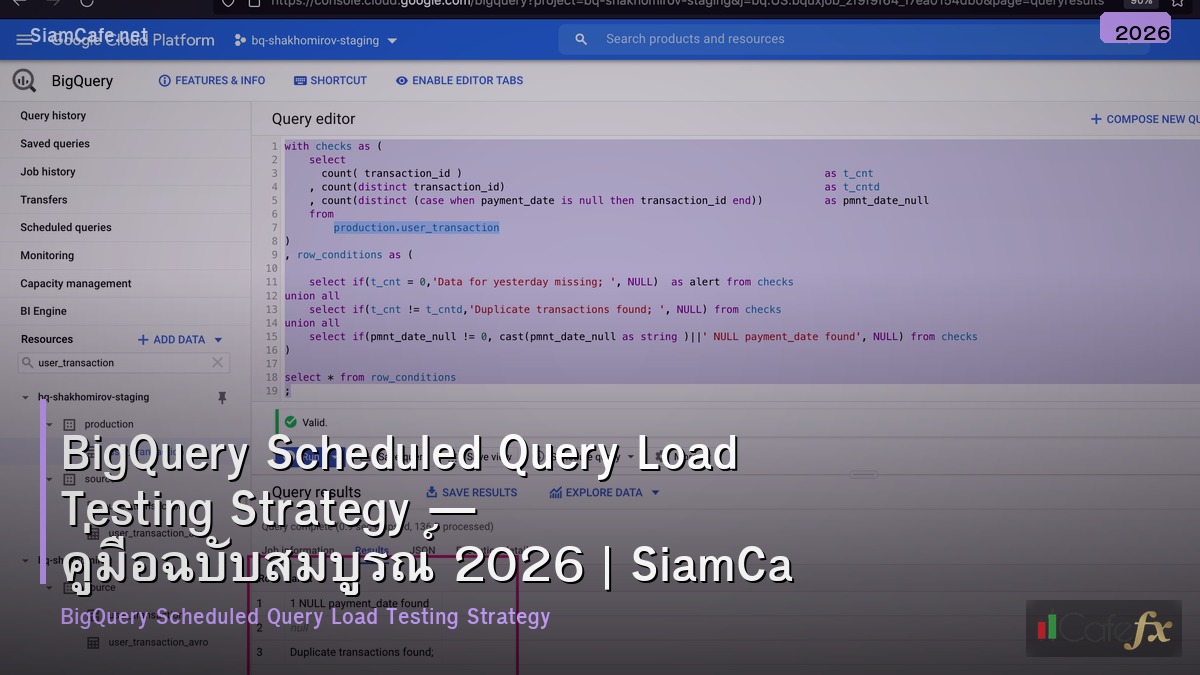
BigQuery Scheduled Query Load Testing Strategy

bigquery scheduled query load testing strategy
BigQuery Scheduled Query Load Testing Strategy | SiamCafe Blog
2025-12-27· อ. บอม — SiamCafe.net· 10,049 คำ

BigQuery Load Testing

BigQuery Scheduled Query Load Testing Performance Baseline Stress Testing Slot Estimation Cost Forecasting Production Monitoring

MetricSourceTargetAlert Threshold
Query DurationINFORMATION_SCHEMA.JOBS< 30 min> 45 min
Bytes ScannedINFORMATION_SCHEMA.JOBSTrend stable> 2x baseline
Slot UsageCloud Monitoring< 80% capacity> 90% capacity
Cost per QueryINFORMATION_SCHEMA.JOBSWithin budget> 150% baseline
Failure RateTransfer Run logs0%> 0% (any failure)
Queue Wait TimeCloud Monitoring< 5 sec> 30 sec

Performance Measurement

# === BigQuery Performance Queries ===

# Query performance from INFORMATION_SCHEMA
# SELECT
#   job_id,
#   query,
#   creation_time,
#   end_time,
#   TIMESTAMP_DIFF(end_time, creation_time, SECOND) AS duration_sec,
#   total_bytes_processed / POW(1024, 3) AS gb_scanned,
#   total_slot_ms,
#   total_slot_ms / NULLIF(TIMESTAMP_DIFF(end_time, creation_time, MILLISECOND), 0) AS avg_slots,
#   (total_bytes_processed / POW(1024, 4)) * 6.25 AS estimated_cost_usd
# FROM `region-us`.INFORMATION_SCHEMA.JOBS
# WHERE job_type = 'QUERY'
#   AND state = 'DONE'
#   AND creation_time > TIMESTAMP_SUB(CURRENT_TIMESTAMP(), INTERVAL 7 DAY)
# ORDER BY total_slot_ms DESC
# LIMIT 50;

# Scheduled Query specific monitoring
# SELECT
#   j.job_id,
#   j.creation_time,
#   TIMESTAMP_DIFF(j.end_time, j.creation_time, SECOND) AS duration_sec,
#   j.total_bytes_processed / POW(1024, 3) AS gb_scanned,
#   j.total_slot_ms,
#   j.error_result.message AS error
# FROM `region-us`.INFORMATION_SCHEMA.JOBS j
# WHERE j.configuration.query.destination_table.dataset_id = 'analytics'
#   AND j.creation_time > TIMESTAMP_SUB(CURRENT_TIMESTAMP(), INTERVAL 30 DAY)
# ORDER BY j.creation_time DESC;

from dataclasses import dataclass

@dataclass
class LoadTest:
    scenario: str
    data_size: str
    expected_duration: str
    expected_slots: int
    expected_cost: str
    pass_criteria: str

tests = [
    LoadTest("Baseline (Current)", "50 GB daily",
        "5 minutes", 500, "$0.31/run",
        "Duration < 10 min, Cost < $0.50"),
    LoadTest("2x Growth", "100 GB daily",
        "8 minutes", 800, "$0.63/run",
        "Duration < 15 min, Cost < $1.00"),
    LoadTest("5x Growth", "250 GB daily",
        "15 minutes", 1500, "$1.56/run",
        "Duration < 30 min, Cost < $2.00"),
    LoadTest("10x Growth", "500 GB daily",
        "25 minutes", 2000+, "$3.13/run",
        "Duration < 45 min, may need Reservation"),
    LoadTest("Peak Concurrent", "5 queries × 50 GB",
        "15 minutes (queued)", 2000, "$1.56 total",
        "All complete < 30 min, no timeout"),
]

print("=== Load Test Scenarios ===")
for t in tests:
    print(f"  [{t.scenario}] Data: {t.data_size}")
    print(f"    Duration: {t.expected_duration} | Slots: {t.expected_slots}")
    print(f"    Cost: {t.expected_cost}")
    print(f"    Pass: {t.pass_criteria}")

Slot and Cost Planning

# === Slot and Cost Calculator ===

@dataclass
class PricingTier:
    tier: str
    pricing: str
    slots: str
    cost_monthly: str
    best_for: str

tiers = [
    PricingTier("On-demand", "$6.25 per TB scanned",
        "Up to 2000 (shared, best effort)",
        "Variable — pay per scan",
        "< $2000/month, unpredictable workload"),
    PricingTier("Standard Edition", "$0.04/slot-hour",
        "Autoscale 0 to max",
        "~$1200/month for 100 baseline slots",
        "$2K-10K/month, need autoscaling"),
    PricingTier("Enterprise Edition", "$0.06/slot-hour",
        "Autoscale + advanced features",
        "~$1800/month for 100 baseline slots",
        "$5K+/month, need governance features"),
    PricingTier("Enterprise Plus", "$0.10/slot-hour",
        "Highest performance + all features",
        "~$3000/month for 100 baseline slots",
        "Large enterprise, mission critical"),
]

print("=== Pricing Tiers ===")
for p in tiers:
    print(f"  [{p.tier}] {p.pricing}")
    print(f"    Slots: {p.slots}")
    print(f"    Monthly: {p.cost_monthly}")
    print(f"    Best for: {p.best_for}")

# Cost estimation
def estimate_monthly_cost(daily_gb, price_per_tb=6.25):
    daily_tb = daily_gb / 1024
    daily_cost = daily_tb * price_per_tb
    monthly_cost = daily_cost * 30
    print(f"  Daily: {daily_gb} GB = {daily_tb:.3f} TB = ")
    print(f"  Monthly: ")
    return monthly_cost

print(f"\n\nCost Estimation (On-demand):")
for gb in [10, 50, 100, 500, 1000]:
    print(f"\n  [{gb} GB/day]")
    estimate_monthly_cost(gb)

Production Monitoring

# === Monitoring Setup ===

@dataclass
class MonitorAlert:
    alert: str
    metric: str
    condition: str
    action: str
    channel: str

alerts = [
    MonitorAlert("Query Duration Spike",
        "INFORMATION_SCHEMA duration",
        "Duration > 2x 7-day average",
        "Check data growth, optimize query, add slots",
        "Slack #data-alerts"),
    MonitorAlert("Cost Spike",
        "Billing export + bytes_processed",
        "Daily cost > 150% of budget",
        "Review queries, check partition pruning",
        "Email + Slack"),
    MonitorAlert("Scheduled Query Failure",
        "Transfer run state = FAILED",
        "Any failure",
        "Check error message, fix and re-run",
        "PagerDuty + Slack"),
    MonitorAlert("Slot Saturation",
        "Cloud Monitoring slot utilization",
        "Slot usage > 90% for 10+ min",
        "Increase reservation or optimize queries",
        "Slack #infra"),
    MonitorAlert("Data Freshness",
        "MAX(timestamp) in destination table",
        "Data > 2 hours stale",
        "Check source, check scheduled query status",
        "Slack #data-quality"),
]

print("=== Production Alerts ===")
for a in alerts:
    print(f"  [{a.alert}]")
    print(f"    Metric: {a.metric}")
    print(f"    Condition: {a.condition}")
    print(f"    Action: {a.action}")
    print(f"    Channel: {a.channel}")

เคล็ดลับ

การนำไปใช้งานจริงในองค์กร

สำหรับองค์กรขนาดกลางถึงใหญ่ แนะนำให้ใช้หลัก Three-Tier Architecture คือ Core Layer ที่เป็นแกนกลางของระบบ Distribution Layer ที่ทำหน้าที่กระจาย Traffic และ Access Layer ที่เชื่อมต่อกับผู้ใช้โดยตรง การแบ่ง Layer ชัดเจนช่วยให้การ Troubleshoot ง่ายขึ้นและสามารถ Scale ระบบได้ตามความต้องการ

เรื่อง Network Security ก็สำคัญไม่แพ้กัน ควรติดตั้ง Next-Generation Firewall ที่สามารถ Deep Packet Inspection ได้ ใช้ Network Segmentation แยก VLAN สำหรับแต่ละแผนก ติดตั้ง IDS/IPS เพื่อตรวจจับการโจมตี และทำ Regular Security Audit อย่างน้อยปีละ 2 ครั้ง

เปรียบเทียบข้อดีและข้อเสีย

ข้อดีข้อเสีย
ประสิทธิภาพสูง ทำงานได้เร็วและแม่นยำ ลดเวลาทำงานซ้ำซ้อนต้องใช้เวลาเรียนรู้เบื้องต้นพอสมควร มี Learning Curve สูง
มี Community ขนาดใหญ่ มีคนช่วยเหลือและแหล่งเรียนรู้มากมายบางฟีเจอร์อาจยังไม่เสถียร หรือมีการเปลี่ยนแปลงบ่อยในเวอร์ชันใหม่
รองรับ Integration กับเครื่องมือและบริการอื่นได้หลากหลายต้นทุนอาจสูงสำหรับ Enterprise License หรือ Cloud Service
เป็น Open Source หรือมีเวอร์ชันฟรีให้เริ่มต้นใช้งานต้องการ Hardware หรือ Infrastructure ที่เพียงพอ

จากตารางเปรียบเทียบจะเห็นว่าข้อดีมีมากกว่าข้อเสียอย่างชัดเจน โดยเฉพาะในแง่ของประสิทธิภาพและความสามารถในการ Scale สำหรับข้อเสียส่วนใหญ่สามารถแก้ไขได้ด้วยการเรียนรู้อย่างเป็นระบบและวางแผนทรัพยากรให้เหมาะสม

Load Testing สำหรับ BigQuery คืออะไร

ทดสอบ Scheduled Query ข้อมูลเพิ่ม 10x 50x 100x Duration Slot Bytes Cost SLA Concurrent Peak Load

วัดประสิทธิภาพอย่างไร

INFORMATION_SCHEMA.JOBS total_bytes_processed total_slot_ms Duration Audit Logs Cloud Monitoring Query Plan Shuffle Spill

Slot Estimation ทำอย่างไร

total_slot_ms หาร Duration Average Slots On-demand 2000 Default Queue Reservation Flex Slots Edition Standard Enterprise

Cost Forecasting ทำอย่างไร

On-demand $6.25 per TB Dry Run Monthly Cost Reservation Budget Alert Partitioned Clustering INFORMATION_SCHEMA Edition Pricing

สรุป

BigQuery Scheduled Query Load Testing Performance Slot Estimation Cost Forecasting Partition Clustering Monitoring Alert Edition Production

📖 บทความที่เกี่ยวข้อง

BigQuery Scheduled Query Distributed Systemอ่านบทความ → BigQuery Scheduled Query Zero Downtime Deploymentอ่านบทความ → BigQuery Scheduled Query Business Continuityอ่านบทความ → BigQuery Scheduled Query Learning Path Roadmapอ่านบทความ → BigQuery Scheduled Query Team Productivityอ่านบทความ →

📚 ดูบทความทั้งหมด →