ACME Protocol Tech Conference 2026 — คู่มือฉบับสมบูรณ์ 2026
ACME Protocol Tech Conference 2026 คืออะไร
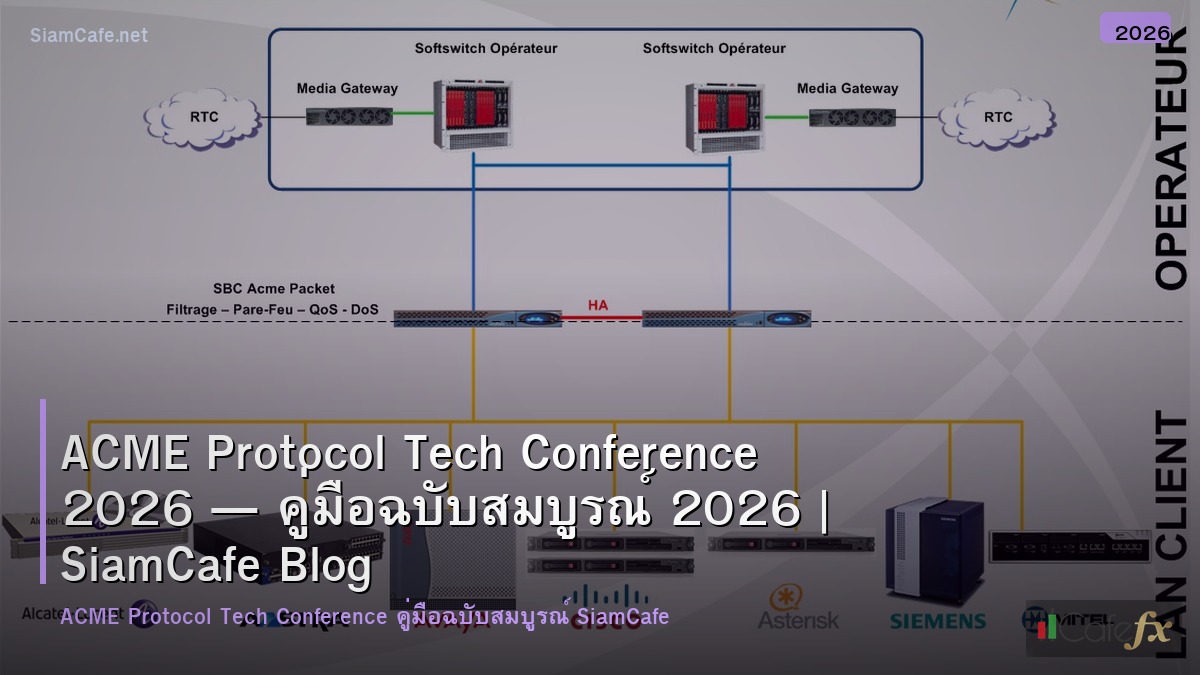
ACME (Automatic Certificate Management Environment) Protocol เป็นมาตรฐาน IETF (RFC 8555) สำหรับจัดการ SSL/TLS certificates อัตโนมัติ พัฒนาโดย Let's Encrypt และ ISRG (Internet Security Research Group) ACME ทำให้การขอ ต่ออายุ และ revoke certificates เป็นกระบวนการอัตโนมัติ 100% ไม่ต้องทำมือ Tech Conference 2026 เป็นโอกาสดีในการเรียนรู้ trends ใหม่ของ ACME ecosystem รวมถึง short-lived certificates, ACME for IoT และ post-quantum readiness
ACME Protocol Fundamentals
# acme_basics.py — ACME Protocol fundamentals

import json


class ACMEBasics:

 FLOW = {

 "step1": {"name": "Account Registration", "description": "สร้าง account กับ CA (Certificate Authority) — ส่ง public key"},

 "step2": {"name": "Order Certificate", "description": "ขอ certificate สำหรับ domain — ระบุ identifiers"},

 "step3": {"name": "Authorization", "description": "พิสูจน์ว่าเป็นเจ้าของ domain — HTTP-01, DNS-01, TLS-ALPN-01 challenges"},

 "step4": {"name": "Challenge Validation", "description": "CA ตรวจสอบ challenge — ถ้าผ่านจะ authorize"},

 "step5": {"name": "Finalize Order", "description": "ส่ง CSR (Certificate Signing Request) → CA ออก certificate"},

 "step6": {"name": "Download Certificate", "description": "ดาวน์โหลด certificate + chain → ติดตั้งบน server"},

 }


 CHALLENGES = {

 "http01": {

 "name": "HTTP-01",

 "description": "วาง file บน web server ที่ /.well-known/acme-challenge/TOKEN",

 "pros": "ง่ายที่สุด, ใช้กับ web server ทั่วไป",

 "cons": "ต้องเปิด port 80, ไม่ได้ wildcard",

 },

 "dns01": {

 "name": "DNS-01",

 "description": "สร้าง TXT record _acme-challenge.domain.com",

 "pros": "ได้ wildcard certificate, ไม่ต้องเปิด port",

 "cons": "ต้อง API access กับ DNS provider, propagation delay",

 },

 "tlsalpn01": {

 "name": "TLS-ALPN-01",

 "description": "ใช้ TLS handshake กับ ALPN extension พิสูจน์ identity",

 "pros": "ไม่ต้องเปิด port 80, ใช้ port 443 เดิม",

 "cons": "ซับซ้อนกว่า, ไม่ค่อยมี client รองรับ",

 },

 }


 CLIENTS = {

 "certbot": "Certbot — client ยอดนิยมจาก EFF, Python-based",

 "acmesh": "acme.sh — shell script client, lightweight, DNS plugins เยอะ",

 "caddy": "Caddy — web server ที่มี ACME built-in (auto HTTPS)",

 "lego": "Lego — Go-based client, รองรับ DNS providers เยอะ",

 "traefik": "Traefik — reverse proxy ที่มี ACME built-in",

 }


 def show_flow(self):

 print("=== ACME Flow ===\n")

 for key, step in self.FLOW.items():

 print(f" [{step['name']}] {step['description']}")


 def show_challenges(self):

 print(f"\n=== Challenge Types ===")

 for key, ch in self.CHALLENGES.items():

 print(f"\n[{ch['name']}]")

 print(f" {ch['description']}")

 print(f" Pros: {ch['pros']}")


 def show_clients(self):

 print(f"\n=== ACME Clients ===")

 for name, desc in self.CLIENTS.items():

 print(f" [{name}] {desc}")


basics = ACMEBasics()

basics.show_flow()

basics.show_challenges()

basics.show_clients()
Conference Topics 2026
# conference.py — ACME Tech Conference 2026 topics

import json


class ConferenceTopics:

 TOPICS = {

 "short_lived": {

 "name": "Short-Lived Certificates (6-hour / 90-day)",

 "description": "Trend ใหม่: certificates อายุสั้นลง — Google เสนอ 90 วัน, บาง CA ให้ 6 ชั่วโมง",

 "benefit": "ลดความเสี่ยงจาก compromised keys — revocation ไม่ทัน",

 "challenge": "ต้อง automation 100% — manual renewal เป็นไปไม่ได้",

 },

 "post_quantum": {

 "name": "Post-Quantum ACME",

 "description": "เตรียมพร้อมสำหรับ quantum computing — certificates ที่ใช้ PQ algorithms",

 "algorithms": "ML-KEM (Kyber), ML-DSA (Dilithium), SLH-DSA (SPHINCS+)",

 "timeline": "NIST standards finalized 2024 → adoption 2025-2030",

 },

 "acme_iot": {

 "name": "ACME for IoT Devices",

 "description": "ใช้ ACME กับ IoT devices — device attestation + certificate management",

 "challenge": "Resource constraints, intermittent connectivity, device identity",

 },

 "multi_ca": {

 "name": "Multi-CA Strategy",

 "description": "ใช้หลาย CA providers — redundancy เมื่อ CA ล่ม",

 "example": "Let's Encrypt + ZeroSSL + Google Trust Services",

 },

 "cert_transparency": {

 "name": "Certificate Transparency (CT) Monitoring",

 "description": "Monitor CT logs เพื่อตรวจจับ mis-issuance — ป้องกัน fraudulent certs",

 },

 }


 WORKSHOPS = {

 "w1": "Hands-on: Certbot Advanced Configuration + DNS-01 Automation",

 "w2": "Building Custom ACME Clients in Python",

 "w3": "Kubernetes cert-manager Deep Dive",

 "w4": "Zero-Touch Certificate Management for Enterprise",

 "w5": "Post-Quantum Certificate Migration Planning",

 }


 def show_topics(self):

 print("=== Conference Topics 2026 ===\n")

 for key, topic in self.TOPICS.items():

 print(f"[{topic['name']}]")

 print(f" {topic['description']}")

 print()


 def show_workshops(self):

 print("=== Workshops ===")

 for key, ws in self.WORKSHOPS.items():

 print(f" [{key}] {ws}")


conf = ConferenceTopics()

conf.show_topics()

conf.show_workshops()
Python ACME Client
# acme_client.py — Python ACME client implementation

import json


class PythonACMEClient:

 CODE = """

# acme_manager.py — Manage certificates with ACME

import requests

import json

import hashlib

import base64

from datetime import datetime, timedelta

from cryptography import x509

from cryptography.hazmat.primitives import hashes, serialization

from cryptography.hazmat.primitives.asymmetric import rsa


class ACMEManager:

 def __init__(self, directory_url="https://acme-v02.api.letsencrypt.org/directory"):

 self.directory_url = directory_url

 self.directory = None

 self.account_key = None

 self.account_url = None


 def get_directory(self):

 '''Fetch ACME directory'''

 resp = requests.get(self.directory_url)

 self.directory = resp.json()

 return self.directory


 def generate_account_key(self):

 '''Generate RSA account key'''

 self.account_key = rsa.generate_private_key(

 public_exponent=65537,

 key_size=2048,

 )

 return self.account_key


 def check_certificate(self, domain, port=443):

 '''Check current certificate status'''

 import ssl

 import socket


 context = ssl.create_default_context()

 with socket.create_connection((domain, port), timeout=10) as sock:

 with context.wrap_socket(sock, server_hostname=domain) as ssock:

 cert = ssock.getpeercert()


 not_after = datetime.strptime(cert['notAfter'], '%b %d %H:%M:%S %Y %Z')

 days_left = (not_after - datetime.utcnow()).days


 return {

 'domain': domain,

 'issuer': dict(x[0] for x in cert['issuer']),

 'subject': dict(x[0] for x in cert['subject']),

 'not_before': cert['notBefore'],

 'not_after': cert['notAfter'],

 'days_remaining': days_left,

 'needs_renewal': days_left < 30,

 'san': [

 entry[1] for entry in cert.get('subjectAltName', [])

 ],

 }


 def monitor_certificates(self, domains):

 '''Monitor multiple domain certificates'''

 results = []

 for domain in domains:

 try:

 info = self.check_certificate(domain)

 results.append(info)

 except Exception as e:

 results.append({

 'domain': domain,

 'error': str(e),

 'needs_renewal': True,

 })


 return {

 'timestamp': datetime.utcnow().isoformat(),

 'total_domains': len(domains),

 'needs_renewal': sum(1 for r in results if r.get('needs_renewal')),

 'certificates': results,

 }


 def ct_log_check(self, domain):

 '''Check Certificate Transparency logs'''

 url = f"https://crt.sh/?q={domain}&output=json"

 resp = requests.get(url, timeout=15)


 if resp.status_code == 200:

 certs = resp.json()

 return {

 'domain': domain,

 'total_certs': len(certs),

 'recent': [

 {

 'issuer': c.get('issuer_name', ''),

 'not_before': c.get('not_before', ''),

 'not_after': c.get('not_after', ''),

 }

 for c in certs[:5]

 ],

 }

 return {'error': 'CT log query failed'}


# mgr = ACMEManager()

# cert = mgr.check_certificate("example.com")

# report = mgr.monitor_certificates(["example.com", "api.example.com"])

"""


 def show_code(self):

 print("=== Python ACME Client ===")

 print(self.CODE[:600])


client = PythonACMEClient()

client.show_code()
Kubernetes cert-manager
# cert_manager.py — Kubernetes cert-manager setup

import json


class CertManager:

 MANIFESTS = """

# cert-manager installation + ACME issuer

# 1. Install cert-manager

# kubectl apply -f https://github.com/cert-manager/cert-manager/releases/download/v1.14.0/cert-manager.yaml


# 2. ClusterIssuer for Let's Encrypt

apiVersion: cert-manager.io/v1

kind: ClusterIssuer

metadata:

 name: letsencrypt-prod

spec:

 acme:

 server: https://acme-v02.api.letsencrypt.org/directory

 email: admin@example.com

 privateKeySecretRef:

 name: letsencrypt-prod-key

 solvers:

 - http01:

 ingress:

 class: nginx

 - dns01:

 cloudDNS:

 project: my-gcp-project

 selector:

 dnsZones:

 - "example.com"


# 3. Certificate resource

---

apiVersion: cert-manager.io/v1

kind: Certificate

metadata:

 name: example-cert

 namespace: default

spec:

 secretName: example-tls

 issuerRef:

 name: letsencrypt-prod

 kind: ClusterIssuer

 commonName: example.com

 dnsNames:

 - example.com

 - "*.example.com"

 duration: 2160h # 90 days

 renewBefore: 720h # Renew 30 days before expiry

"""


 MONITORING = {

 "prometheus": "cert-manager มี Prometheus metrics built-in",

 "grafana": "Dashboard: cert-manager / Certificates overview",

 "alerts": [

 "CertificateNotReady — cert ไม่พร้อมใช้งาน",

 "CertificateExpiringSoon — cert จะหมดอายุใน 7 วัน",

 "ACMEOrderFailed — ACME order ล้มเหลว",

 ],

 }


 def show_manifests(self):

 print("=== cert-manager Setup ===")

 print(self.MANIFESTS[:500])


 def show_monitoring(self):

 print(f"\n=== Monitoring ===")

 for alert in self.MONITORING['alerts']:

 print(f" • {alert}")


cm = CertManager()

cm.show_manifests()

cm.show_monitoring()
Conference Preparation
# preparation.py — Conference preparation guide

import json


class ConferencePrep:

 SKILLS = {

 "beginner": {

 "level": "Beginner",

 "topics": ["ACME basics + Let's Encrypt", "Certbot usage", "HTTP-01 challenge", "Certificate lifecycle"],

 "prep": "ลอง setup Let's Encrypt บน VPS ด้วย Certbot",

 },

 "intermediate": {

 "level": "Intermediate",

 "topics": ["DNS-01 automation", "Wildcard certificates", "cert-manager on K8s", "Multi-domain management"],

 "prep": "Setup cert-manager + ClusterIssuer + automatic renewal",

 },

 "advanced": {

 "level": "Advanced",

 "topics": ["Custom ACME clients", "Short-lived certificates", "Post-quantum readiness", "CT log monitoring"],

 "prep": "Build custom ACME workflow + monitoring dashboard",

 },

 }


 NETWORKING = {

 "communities": [

 "Let's Encrypt Community Forum",

 "cert-manager Slack (#cert-manager)",

 "IETF ACME Working Group mailing list",

 ],

 "talks": [

 "ฟัง talks ทั้งหมด — จด notes",

 "ถามคำถามใน Q&A sessions",

 "เข้า workshops hands-on",

 "แลก contact กับ speakers และ attendees",

 ],

 }


 def show_skills(self):

 print("=== Preparation by Level ===\n")

 for key, level in self.SKILLS.items():

 print(f"[{level['level']}]")

 print(f" Prep: {level['prep']}")

 for topic in level['topics'][:2]:

 print(f" • {topic}")

 print()


 def show_networking(self):

 print("=== Networking ===")

 for comm in self.NETWORKING['communities']:

 print(f" • {comm}")


prep = ConferencePrep()

prep.show_skills()

prep.show_networking()
FAQ - คำถามที่พบบ่อย
Q: Let's Encrypt ฟรีจริงไหม?
อ่านเพิ่ม: Home Lab 2026 คู่มือสร้างห้อง Server ที่บ้าน ครบทุกอย่าง · อ่านเพิ่ม: Kubernetes Networking คืออะไร? สอน Service, Ingress, DNS และ · อ่านเพิ่ม: cert-manager คืออะไร? สอนจัดการ TLS Certificate อัตโนมัติบน
A: ฟรี 100% — ไม่มีค่าใช้จ่ายใดๆ Let's Encrypt เป็น nonprofit CA (ISRG) ได้ทุน sponsor จาก Google, Mozilla, Cisco, Meta ข้อจำกัด: certificate อายุ 90 วัน (ต้อง renew อัตโนมัติ), ไม่มี EV/OV certificates Rate limits: 50 certificates per domain per week, 300 orders per account per 3 hours
Q: ACME ใช้กับ CA อื่นนอกจาก Let's Encrypt ได้ไหม?
A: ได้ — ACME เป็น standard protocol (RFC 8555) CA อื่นที่รองรับ: ZeroSSL, Google Trust Services, Buypass, SSL.com ข้อดีของ multi-CA: redundancy เมื่อ CA ล่ม, ลด dependency กับ provider เดียว cert-manager รองรับหลาย issuers — ตั้ง fallback ได้
Q: Short-lived certificates (6 ชั่วโมง) ดีกว่า 90 วันอย่างไร?
A: ปลอดภัยกว่า: ถ้า key ถูก compromise → certificate หมดอายุเร็ว ไม่ต้อง revoke ไม่ต้อง CRL/OCSP: clients ไม่ต้อง check revocation status — ลด latency ข้อเสีย: ต้อง automation ที่ robust มาก — renewal ล้มเหลว = downtime ทันที ใช้เมื่อ: internal services, microservices, environments ที่ control ได้ 100%
Q: Post-Quantum certificates เริ่มใช้เมื่อไหร่?
A: NIST finalized PQ standards ในปี 2024 (ML-KEM, ML-DSA) Timeline: 2025-2026 experimental support ใน browsers/servers 2027-2028 hybrid certificates (classical + PQ) เป็น default 2030+ PQ-only certificates สิ่งที่ต้องเตรียม: inventory ของ certificates ทั้งหมด, test PQ algorithms กับ infrastructure, plan migration path