Technology

Best Books Technical Analysis — หนังสือวิเคราะห์ทางเทคนิคที่ดีที่สุด
best books technical analysis
best books technical analysis | SiamCafe Blog
2026-05-21· อ. บอม — SiamCafe.net· 1,215 คำ

Technical Analysis คืออะไร

Technical Analysis เป็นการวิเคราะห์การเคลื่อนไหวของราคาและปริมาณการซื้อขาย (volume) เพื่อคาดการณ์ทิศทางราคาในอนาคต ใช้ chart patterns, indicators และ statistical methods แทนการวิเคราะห์ปัจจัยพื้นฐาน (fundamental analysis)

หลักการสำคัญของ Technical Analysis ได้แก่ Price discounts everything ราคาสะท้อนข้อมูลทั้งหมดแล้ว, Prices move in trends ราคาเคลื่อนไหวเป็นแนวโน้ม, History tends to repeat itself รูปแบบราคาในอดีตมักเกิดซ้ำ เครื่องมือหลัก ได้แก่ Trend lines และ channels, Support และ Resistance levels, Moving Averages (SMA, EMA), Oscillators (RSI, MACD, Stochastic), Volume analysis, Chart patterns (Head and Shoulders, Double Top/Bottom, Triangles) และ Candlestick patterns

สำหรับ developers การเข้าใจ Technical Analysis ช่วยในการสร้าง automated trading systems, backtesting frameworks, charting libraries, signal generation engines และ risk management tools

หนังสือ Technical Analysis ที่ดีที่สุด

รายชื่อหนังสือที่แนะนำสำหรับเรียน Technical Analysis ตั้งแต่พื้นฐานจนถึงขั้นสูง โดยแบ่งตามระดับ

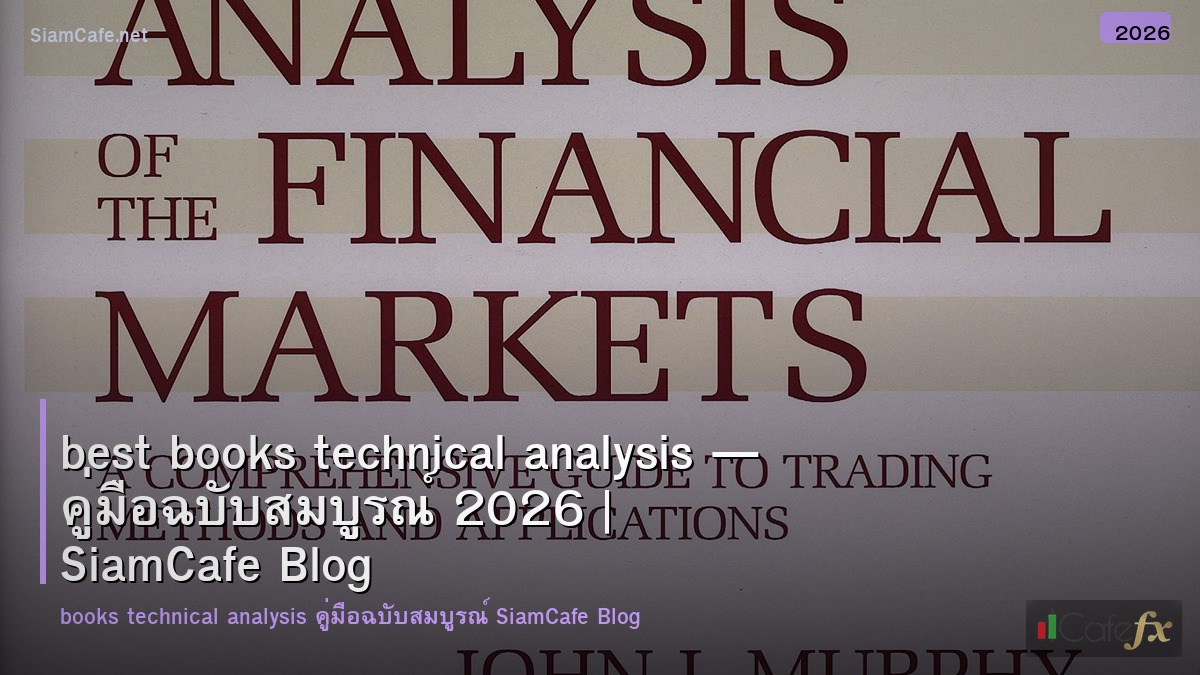
สำหรับผู้เริ่มต้น Technical Analysis of the Financial Markets โดย John J. Murphy เป็นหนังสือ classic ที่ครอบคลุมทุกด้านของ TA ตั้งแต่ chart patterns, indicators, intermarket analysis เหมาะเป็นหนังสือเล่มแรก Japanese Candlestick Charting Techniques โดย Steve Nison เป็นหนังสือที่แนะนำ candlestick patterns อย่างละเอียด เป็นคนแรกที่นำ candlestick จากญี่ปุ่นมาเผยแพร่ในตะวันตก

สำหรับระดับกลาง Trading for a Living โดย Dr. Alexander Elder ครอบคลุมทั้ง psychology, trading methods และ money management ใช้ Triple Screen Trading System Encyclopedia of Chart Patterns โดย Thomas Bulkowski รวม chart patterns ทั้งหมดพร้อมสถิติ success rate จากข้อมูลจริง

สำหรับระดับสูง Technical Analysis Using Multiple Timeframes โดย Brian Shannon วิเคราะห์หลาย timeframes พร้อมกัน Quantitative Technical Analysis โดย Howard Bandy ใช้ statistics และ programming สำหรับ systematic trading Evidence-Based Technical Analysis โดย David Aronson ใช้ scientific method ทดสอบ TA methods

สร้าง Technical Analysis Tools ด้วย Python

เครื่องมือวิเคราะห์ทางเทคนิค

#!/usr/bin/env python3
# technical_analysis.py — Technical Analysis Library
import json
import math
import logging
from typing import List, Dict, Optional, Tuple
from dataclasses import dataclass

logging.basicConfig(level=logging.INFO)
logger = logging.getLogger("ta")

@dataclass
class OHLCV:
    timestamp: str
    open: float
    high: float
    low: float
    close: float
    volume: float

class TechnicalIndicators:
    @staticmethod
    def sma(prices: List[float], period: int) -> List[Optional[float]]:
        """Simple Moving Average"""
        result = [None] * (period - 1)
        for i in range(period - 1, len(prices)):
            window = prices[i - period + 1:i + 1]
            result.append(round(sum(window) / period, 4))
        return result
    
    @staticmethod
    def ema(prices: List[float], period: int) -> List[Optional[float]]:
        """Exponential Moving Average"""
        multiplier = 2 / (period + 1)
        result = [None] * (period - 1)
        
        # First EMA = SMA
        first_sma = sum(prices[:period]) / period
        result.append(round(first_sma, 4))
        
        for i in range(period, len(prices)):
            ema_val = (prices[i] - result[-1]) * multiplier + result[-1]
            result.append(round(ema_val, 4))
        
        return result
    
    @staticmethod
    def rsi(prices: List[float], period: int = 14) -> List[Optional[float]]:
        """Relative Strength Index"""
        if len(prices) < period + 1:
            return [None] * len(prices)
        
        changes = [prices[i] - prices[i-1] for i in range(1, len(prices))]
        
        gains = [max(c, 0) for c in changes]
        losses = [abs(min(c, 0)) for c in changes]
        
        result = [None] * period
        
        avg_gain = sum(gains[:period]) / period
        avg_loss = sum(losses[:period]) / period
        
        if avg_loss == 0:
            result.append(100.0)
        else:
            rs = avg_gain / avg_loss
            result.append(round(100 - (100 / (1 + rs)), 2))
        
        for i in range(period, len(changes)):
            avg_gain = (avg_gain * (period - 1) + gains[i]) / period
            avg_loss = (avg_loss * (period - 1) + losses[i]) / period
            
            if avg_loss == 0:
                result.append(100.0)
            else:
                rs = avg_gain / avg_loss
                result.append(round(100 - (100 / (1 + rs)), 2))
        
        return result
    
    @staticmethod
    def macd(prices: List[float], fast=12, slow=26, signal=9):
        """MACD (Moving Average Convergence Divergence)"""
        ema_fast = TechnicalIndicators.ema(prices, fast)
        ema_slow = TechnicalIndicators.ema(prices, slow)
        
        macd_line = []
        for f, s in zip(ema_fast, ema_slow):
            if f is not None and s is not None:
                macd_line.append(round(f - s, 4))
            else:
                macd_line.append(None)
        
        valid_macd = [v for v in macd_line if v is not None]
        signal_line_raw = TechnicalIndicators.ema(valid_macd, signal)
        
        signal_line = [None] * (len(macd_line) - len(signal_line_raw)) + signal_line_raw
        
        histogram = []
        for m, s in zip(macd_line, signal_line):
            if m is not None and s is not None:
                histogram.append(round(m - s, 4))
            else:
                histogram.append(None)
        
        return {
            "macd": macd_line,
            "signal": signal_line,
            "histogram": histogram,
        }
    
    @staticmethod
    def bollinger_bands(prices: List[float], period=20, std_dev=2):
        """Bollinger Bands"""
        sma = TechnicalIndicators.sma(prices, period)
        
        upper = []
        lower = []
        
        for i in range(len(prices)):
            if sma[i] is None:
                upper.append(None)
                lower.append(None)
            else:
                window = prices[max(0, i - period + 1):i + 1]
                mean = sum(window) / len(window)
                variance = sum((x - mean) ** 2 for x in window) / len(window)
                std = math.sqrt(variance)
                
                upper.append(round(sma[i] + std_dev * std, 4))
                lower.append(round(sma[i] - std_dev * std, 4))
        
        return {"upper": upper, "middle": sma, "lower": lower}
    
    @staticmethod
    def support_resistance(prices: List[float], window=20):
        """Find support and resistance levels"""
        levels = []
        
        for i in range(window, len(prices) - window):
            # Local maximum (resistance)
            if prices[i] == max(prices[i-window:i+window+1]):
                levels.append({"type": "resistance", "price": prices[i], "index": i})
            
            # Local minimum (support)
            if prices[i] == min(prices[i-window:i+window+1]):
                levels.append({"type": "support", "price": prices[i], "index": i})
        
        return levels

# Example usage
import random
random.seed(42)
prices = [100]
for _ in range(99):
    prices.append(round(prices[-1] * (1 + random.gauss(0.0005, 0.02)), 2))

ta = TechnicalIndicators()
print("SMA(20):", ta.sma(prices, 20)[-5:])
print("EMA(12):", ta.ema(prices, 12)[-5:])
print("RSI(14):", ta.rsi(prices, 14)[-5:])
print("MACD:", {k: [v for v in vals[-3:] if v] for k, vals in ta.macd(prices).items()})
print("Bollinger:", {k: [v for v in vals[-3:] if v] for k, vals in ta.bollinger_bands(prices).items()})

Backtesting Strategies จากหนังสือ

ทดสอบกลยุทธ์จากหนังสือ

#!/usr/bin/env python3
# backtest_strategies.py — Backtest Classic TA Strategies
import json
import math
import random
import logging
from typing import List, Dict

logging.basicConfig(level=logging.INFO)
logger = logging.getLogger("backtest")

class SimpleBacktester:
    def __init__(self, initial_capital=100000):
        self.initial_capital = initial_capital
        self.capital = initial_capital
        self.position = 0
        self.trades = []
        self.equity_curve = [initial_capital]
    
    def buy(self, price, size=None):
        if self.position > 0:
            return
        if size is None:
            size = int(self.capital * 0.95 / price)
        cost = size * price
        if cost > self.capital:
            return
        self.position = size
        self.capital -= cost
        self.trades.append({"type": "buy", "price": price, "size": size})
    
    def sell(self, price):
        if self.position <= 0:
            return
        revenue = self.position * price
        self.capital += revenue
        self.trades.append({"type": "sell", "price": price, "size": self.position, "pnl": revenue - self.trades[-1]["price"] * self.position})
        self.position = 0
    
    def get_equity(self, current_price):
        return self.capital + self.position * current_price
    
    def get_results(self, final_price):
        if self.position > 0:
            self.sell(final_price)
        
        total_return = (self.capital - self.initial_capital) / self.initial_capital * 100
        
        wins = [t for t in self.trades if t.get("pnl", 0) > 0]
        losses = [t for t in self.trades if t.get("pnl", 0) < 0]
        
        # Max drawdown
        peak = self.equity_curve[0]
        max_dd = 0
        for eq in self.equity_curve:
            if eq > peak:
                peak = eq
            dd = (peak - eq) / peak * 100
            max_dd = max(max_dd, dd)
        
        sell_trades = [t for t in self.trades if t["type"] == "sell"]
        
        return {
            "initial_capital": self.initial_capital,
            "final_capital": round(self.capital, 2),
            "total_return_pct": round(total_return, 2),
            "total_trades": len(sell_trades),
            "winning_trades": len(wins),
            "losing_trades": len(losses),
            "win_rate_pct": round(len(wins) / max(len(sell_trades), 1) * 100, 1),
            "max_drawdown_pct": round(max_dd, 2),
        }

def generate_prices(start=100, days=500, seed=42):
    random.seed(seed)
    prices = [start]
    for _ in range(days - 1):
        change = random.gauss(0.0003, 0.015)
        prices.append(round(prices[-1] * (1 + change), 2))
    return prices

def sma_crossover_strategy(prices, fast=10, slow=30):
    """Golden Cross / Death Cross strategy from Murphy's book"""
    bt = SimpleBacktester()
    
    for i in range(slow, len(prices)):
        fast_sma = sum(prices[i-fast:i]) / fast
        slow_sma = sum(prices[i-slow:i]) / slow
        prev_fast = sum(prices[i-fast-1:i-1]) / fast
        prev_slow = sum(prices[i-slow-1:i-1]) / slow
        
        # Golden Cross: fast crosses above slow
        if prev_fast <= prev_slow and fast_sma > slow_sma:
            bt.buy(prices[i])
        # Death Cross: fast crosses below slow
        elif prev_fast >= prev_slow and fast_sma < slow_sma:
            bt.sell(prices[i])
        
        bt.equity_curve.append(bt.get_equity(prices[i]))
    
    return bt.get_results(prices[-1])

def rsi_strategy(prices, period=14, oversold=30, overbought=70):
    """RSI strategy from Elder's book"""
    bt = SimpleBacktester()
    
    changes = [prices[i] - prices[i-1] for i in range(1, len(prices))]
    
    for i in range(period + 1, len(prices)):
        window = changes[i-period:i]
        gains = [max(c, 0) for c in window]
        losses_ = [abs(min(c, 0)) for c in window]
        
        avg_gain = sum(gains) / period
        avg_loss = sum(losses_) / period
        
        if avg_loss == 0:
            rsi = 100
        else:
            rs = avg_gain / avg_loss
            rsi = 100 - (100 / (1 + rs))
        
        if rsi < oversold:
            bt.buy(prices[i])
        elif rsi > overbought:
            bt.sell(prices[i])
        
        bt.equity_curve.append(bt.get_equity(prices[i]))
    
    return bt.get_results(prices[-1])

def bollinger_bounce_strategy(prices, period=20, std_dev=2):
    """Bollinger Bands bounce strategy"""
    bt = SimpleBacktester()
    
    for i in range(period, len(prices)):
        window = prices[i-period:i]
        sma = sum(window) / period
        std = math.sqrt(sum((x - sma) ** 2 for x in window) / period)
        
        upper = sma + std_dev * std
        lower = sma - std_dev * std
        
        if prices[i] <= lower:
            bt.buy(prices[i])
        elif prices[i] >= upper:
            bt.sell(prices[i])
        
        bt.equity_curve.append(bt.get_equity(prices[i]))
    
    return bt.get_results(prices[-1])

# Run backtests
prices = generate_prices(100, 500)

strategies = {
    "SMA Crossover (10/30)": sma_crossover_strategy(prices, 10, 30),
    "RSI (14, 30/70)": rsi_strategy(prices),
    "Bollinger Bounce (20, 2)": bollinger_bounce_strategy(prices),
}

print("=== Backtest Results ===")
for name, result in strategies.items():
    print(f"\n{name}:")
    print(json.dumps(result, indent=2))

Automated Chart Pattern Recognition

ระบบตรวจจับ chart patterns อัตโนมัติ

#!/usr/bin/env python3
# pattern_recognition.py — Chart Pattern Detection
import json
import logging
from typing import List, Dict, Tuple, Optional

logging.basicConfig(level=logging.INFO)
logger = logging.getLogger("patterns")

class ChartPatternDetector:
    def __init__(self, prices: List[float]):
        self.prices = prices
        self.pivots = self._find_pivots()
    
    def _find_pivots(self, window=5):
        pivots = []
        for i in range(window, len(self.prices) - window):
            if self.prices[i] == max(self.prices[i-window:i+window+1]):
                pivots.append({"type": "high", "index": i, "price": self.prices[i]})
            elif self.prices[i] == min(self.prices[i-window:i+window+1]):
                pivots.append({"type": "low", "index": i, "price": self.prices[i]})
        return pivots
    
    def detect_double_top(self, tolerance=0.02):
        """Detect Double Top pattern (bearish reversal)"""
        patterns = []
        highs = [p for p in self.pivots if p["type"] == "high"]
        
        for i in range(len(highs) - 1):
            h1, h2 = highs[i], highs[i + 1]
            
            price_diff = abs(h1["price"] - h2["price"]) / h1["price"]
            
            if price_diff < tolerance and h2["index"] - h1["index"] > 10:
                # Find neckline (lowest point between the two tops)
                between = self.prices[h1["index"]:h2["index"]+1]
                neckline = min(between)
                
                patterns.append({
                    "pattern": "double_top",
                    "signal": "bearish",
                    "top1": {"index": h1["index"], "price": h1["price"]},
                    "top2": {"index": h2["index"], "price": h2["price"]},
                    "neckline": round(neckline, 2),
                    "target": round(neckline - (h1["price"] - neckline), 2),
                })
        
        return patterns
    
    def detect_double_bottom(self, tolerance=0.02):
        """Detect Double Bottom pattern (bullish reversal)"""
        patterns = []
        lows = [p for p in self.pivots if p["type"] == "low"]
        
        for i in range(len(lows) - 1):
            l1, l2 = lows[i], lows[i + 1]
            
            price_diff = abs(l1["price"] - l2["price"]) / l1["price"]
            
            if price_diff < tolerance and l2["index"] - l1["index"] > 10:
                between = self.prices[l1["index"]:l2["index"]+1]
                neckline = max(between)
                
                patterns.append({
                    "pattern": "double_bottom",
                    "signal": "bullish",
                    "bottom1": {"index": l1["index"], "price": l1["price"]},
                    "bottom2": {"index": l2["index"], "price": l2["price"]},
                    "neckline": round(neckline, 2),
                    "target": round(neckline + (neckline - l1["price"]), 2),
                })
        
        return patterns
    
    def detect_head_shoulders(self, tolerance=0.03):
        """Detect Head and Shoulders pattern (bearish reversal)"""
        patterns = []
        highs = [p for p in self.pivots if p["type"] == "high"]
        
        for i in range(len(highs) - 2):
            left, head, right = highs[i], highs[i+1], highs[i+2]
            
            # Head must be highest
            if head["price"] <= left["price"] or head["price"] <= right["price"]:
                continue
            
            # Shoulders should be roughly equal
            shoulder_diff = abs(left["price"] - right["price"]) / left["price"]
            if shoulder_diff > tolerance:
                continue
            
            # Find neckline
            lows_between = [p for p in self.pivots
                          if p["type"] == "low"
                          and left["index"] < p["index"] < right["index"]]
            
            if len(lows_between) >= 2:
                neckline = (lows_between[0]["price"] + lows_between[-1]["price"]) / 2
                
                patterns.append({
                    "pattern": "head_and_shoulders",
                    "signal": "bearish",
                    "left_shoulder": {"index": left["index"], "price": left["price"]},
                    "head": {"index": head["index"], "price": head["price"]},
                    "right_shoulder": {"index": right["index"], "price": right["price"]},
                    "neckline": round(neckline, 2),
                    "target": round(neckline - (head["price"] - neckline), 2),
                })
        
        return patterns
    
    def detect_trend(self, period=50):
        """Detect current trend using moving average"""
        if len(self.prices) < period:
            return "unknown"
        
        current = self.prices[-1]
        sma = sum(self.prices[-period:]) / period
        
        slope_prices = self.prices[-period:]
        first_half = sum(slope_prices[:period//2]) / (period//2)
        second_half = sum(slope_prices[period//2:]) / (period//2)
        
        if current > sma and second_half > first_half:
            return "uptrend"
        elif current < sma and second_half < first_half:
            return "downtrend"
        else:
            return "sideways"
    
    def scan_all_patterns(self):
        results = {
            "trend": self.detect_trend(),
            "double_tops": self.detect_double_top(),
            "double_bottoms": self.detect_double_bottom(),
            "head_shoulders": self.detect_head_shoulders(),
            "pivots_found": len(self.pivots),
        }
        
        total_patterns = (
            len(results["double_tops"]) +
            len(results["double_bottoms"]) +
            len(results["head_shoulders"])
        )
        results["total_patterns"] = total_patterns
        
        return results

# Generate sample data and scan
import random
random.seed(123)
prices = [100]
for _ in range(299):
    prices.append(round(prices[-1] * (1 + random.gauss(0, 0.02)), 2))

detector = ChartPatternDetector(prices)
patterns = detector.scan_all_patterns()
print(json.dumps(patterns, indent=2))

สร้าง Trading Dashboard

Dashboard สำหรับ Technical Analysis

# === Trading Dashboard Architecture ===

# 1. Data Pipeline
# ===================================
# Real-time price data -> Technical indicators -> Signal generation -> Dashboard

# Data sources:
# - Yahoo Finance API (free, delayed)
# - Alpha Vantage API (free tier: 5 calls/min)
# - Binance API (free, real-time crypto)
# - Interactive Brokers API (requires account)

# pip install yfinance pandas ta-lib plotly dash

# 2. Quick Data Fetch Script
# ===================================
#!/usr/bin/env python3
# fetch_data.py

import json
from datetime import datetime

# Using yfinance (pip install yfinance)
# import yfinance as yf
# 
# ticker = yf.Ticker("AAPL")
# df = ticker.history(period="1y")
# 
# # Calculate indicators
# df['SMA_20'] = df['Close'].rolling(20).mean()
# df['SMA_50'] = df['Close'].rolling(50).mean()
# df['RSI'] = calculate_rsi(df['Close'], 14)
# 
# # Generate signals
# df['Signal'] = 'hold'
# df.loc[df['SMA_20'] > df['SMA_50'], 'Signal'] = 'buy'
# df.loc[df['SMA_20'] < df['SMA_50'], 'Signal'] = 'sell'

# 3. Dashboard with Plotly Dash
# ===================================
# app.py
# 
# import dash
# from dash import dcc, html
# import plotly.graph_objects as go
# from plotly.subplots import make_subplots
# 
# app = dash.Dash(__name__)
# 
# fig = make_subplots(
#     rows=3, cols=1,
#     shared_xaxes=True,
#     vertical_spacing=0.03,
#     row_heights=[0.6, 0.2, 0.2],
#     subplot_titles=('Price + MA', 'Volume', 'RSI'),
# )
# 
# # Candlestick chart
# fig.add_trace(go.Candlestick(
#     x=df.index, open=df['Open'], high=df['High'],
#     low=df['Low'], close=df['Close'], name='Price',
# ), row=1, col=1)
# 
# # Moving averages
# fig.add_trace(go.Scatter(
#     x=df.index, y=df['SMA_20'], name='SMA 20',
#     line=dict(color='orange', width=1),
# ), row=1, col=1)
# 
# fig.add_trace(go.Scatter(
#     x=df.index, y=df['SMA_50'], name='SMA 50',
#     line=dict(color='blue', width=1),
# ), row=1, col=1)
# 
# # Volume
# fig.add_trace(go.Bar(
#     x=df.index, y=df['Volume'], name='Volume',
# ), row=2, col=1)
# 
# # RSI
# fig.add_trace(go.Scatter(
#     x=df.index, y=df['RSI'], name='RSI',
#     line=dict(color='purple'),
# ), row=3, col=1)
# 
# fig.add_hline(y=70, line_dash="dash", row=3, col=1)
# fig.add_hline(y=30, line_dash="dash", row=3, col=1)
# 
# fig.update_layout(
#     height=800, template='plotly_dark',
#     xaxis_rangeslider_visible=False,
# )
# 
# app.layout = html.Div([
#     html.H1('Technical Analysis Dashboard'),
#     dcc.Graph(figure=fig),
# ])
# 
# app.run_server(debug=True, port=8050)

# 4. Alert System
# ===================================
# Send alerts when signals trigger
# 
# def check_signals(df):
#     latest = df.iloc[-1]
#     alerts = []
#     
#     if latest['RSI'] < 30:
#         alerts.append(f"RSI oversold: {latest['RSI']:.1f}")
#     elif latest['RSI'] > 70:
#         alerts.append(f"RSI overbought: {latest['RSI']:.1f}")
#     
#     if latest['Close'] < latest['BB_Lower']:
#         alerts.append("Price below lower Bollinger Band")
#     elif latest['Close'] > latest['BB_Upper']:
#         alerts.append("Price above upper Bollinger Band")
#     
#     return alerts

echo "Trading dashboard documented"

FAQ คำถามที่พบบ่อย

Q: Technical Analysis ใช้ได้จริงไหม?

A: มีงานวิจัยทั้งสนับสนุนและคัดค้าน TA ไม่ได้ predict อนาคตได้ 100% แต่ช่วยระบุ probabilities และ manage risk TA ทำงานได้ดีใน trending markets แต่อาจให้ false signals ใน sideways markets ที่สำคัญคือ money management และ risk management ไม่ใช่แค่ entry signals นักเทรดที่ประสบความสำเร็จใช้ TA ร่วมกับ risk management ที่เข้มงวด ไม่ใช่ใช้ TA อย่างเดียว

Q: ควรเริ่มอ่านหนังสือเล่มไหนัก่อน?

A: เริ่มจาก Technical Analysis of the Financial Markets โดย John Murphy เป็นเล่มแรก เพราะครอบคลุมทุกพื้นฐาน อ่านง่าย มีภาพประกอบมาก จากนั้นอ่าน Japanese Candlestick Charting Techniques เพื่อเรียน candlestick patterns จากนั้น Trading for a Living เพื่อเรียน psychology และ money management สำหรับ developers ที่ต้องการ quantitative approach อ่าน Quantitative Technical Analysis โดย Howard Bandy

Q: Indicator ไหนสำคัญที่สุด?

A: ไม่มี indicator ที่ดีที่สุดสำหรับทุกสถานการณ์ แนะนำใช้ combination Moving Averages (SMA/EMA) สำหรับ trend identification, RSI หรือ Stochastic สำหรับ overbought/oversold, MACD สำหรับ momentum และ trend changes, Volume สำหรับ confirm signals, Bollinger Bands สำหรับ volatility อย่าใช้ indicators มากเกินไป (indicator overload) 3-4 indicators ที่ complement กันเพียงพอ

Q: Backtesting สำคัญแค่ไหน?

A: สำคัญมากก่อน trade ด้วยเงินจริง backtesting ช่วยให้เห็นว่ากลยุทธ์ทำงานอย่างไรในอดีต ข้อควรระวัง overfitting (optimize จนดีกับข้อมูลอดีตแต่แย่กับอนาคต), survivorship bias, look-ahead bias (ใช้ข้อมูลอนาคตใน backtesting) ใช้ out-of-sample testing (แบ่งข้อมูลเป็น training/testing) และ walk-forward analysis เสมอ backtesting ที่ดีไม่ได้รับประกันผลในอนาคต แต่กลยุทธ์ที่ fail ใน backtest มักจะ fail ในจริงด้วย

📖 บทความที่เกี่ยวข้อง

gold technical analysis support resistance xauusdอ่านบทความ → best books for technical analysisอ่านบทความ → books technical analysisอ่านบทความ → technical analysis best booksอ่านบทความ → OpenTelemetry SDK Technical Debt Managementอ่านบทความ →

📚 ดูบทความทั้งหมด →